
You will get a senior expert, not a junior. Only 2 spots left this month Book a call
Solar Marketing Agency
The 30% federal residential credit ended on December 31, 2025, and most solar websites are still selling it. Your homeowners now need a different reason to sign, and your marketing needs to be rebuilt around the one you actually have: state incentives, SRECs, third-party ownership and the utility bill that keeps climbing. We build the SEO, paid search and tracking system that produces appointments that sit and contracts that install.
The problem diagnosis
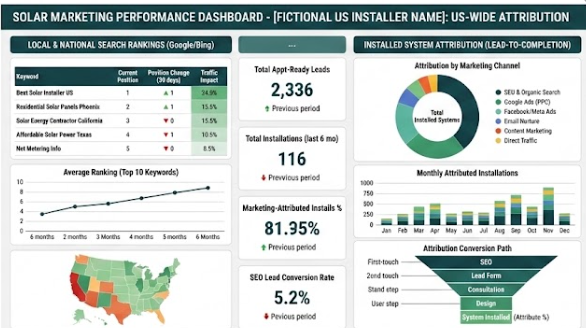
Every issue below comes back to the same thing. Volume is easy to buy in solar. Appointments that sit, close and survive to permission to operate are not, and almost nobody is measuring the difference.

01
The 30% residential credit ended December 31, 2025. If your site, your ads or your proposal deck still lead with it, you are opening every consultation with a correction, and a homeowner who feels misled at minute one does not sign at minute forty. This is the fastest fix on your entire site and most installers still have not made it.
02
The credit did a lot of persuasive work for a decade. Without it, the same ad budget produces the same appointment count and fewer signatures, because the offer got weaker while the copy stayed the same. The fix is not more budget. It is a savings argument built on state incentives, SRECs, TPO pricing and utility rate escalation, said in language a homeowner understands.
03
Lead resellers and national TPO brands own the organic and map results in your territory, then sell you the homeowner four times. Your own site does not rank for solar installers near me in the counties you actually serve, so you rent access to your own market at someone else's margin.
04
The dashboard says 60 leads. It does not say what the sit rate was, what closed, what cancelled during permitting, or what reached PTO. So budget moves toward the cheapest appointment instead of the cheapest installed system, and the channel producing your best-quality homeowners looks expensive.
The Grid Key growth system
Each service works alone. Run together they compound: rankings replace aggregator leads with your own, the site converts homeowners who already trust you, and the reporting ties every install back to where it started.
Own the organic and map results in the counties you install in, so you stop renting leads from aggregators. Google Business Profile optimization, service area pages built on real install volume, solar schema markup, review velocity tied to system activation, and citation cleanup so your NAP matches everywhere Google checks.
A site built for a homeowner doing bill math at 11pm. Fast on mobile, savings calculator that reflects current incentives rather than an expired credit, financing and TPO options side by side, storage and backup as its own path, and booking that lands straight into your CRM.
Google Ads and Performance Max structured by buying stage, not by keyword volume. Research-stage traffic, cost and incentive queries, and ready-to-quote intent each get their own campaign and landing page. Negative lists that block DIY, panel wholesale, installer jobs and aggregator comparison traffic. Bids optimized against installed system value imported from your CRM.
Content that answers what a homeowner asks now that the credit is gone. What incentives still exist in [state], how SRECs actually pay out, lease versus loan versus cash after 25D, whether batteries are worth it under current net metering rules, and what a utility rate increase does to a 25-year payback. Structured to win the Google AI Overview slot and to be the source ChatGPT and Perplexity cite.
Proof and pre-framing. Install walkthroughs, real production data from local systems, crew footage, and homeowner interviews that answer the objection before the consultation. Paid retargeting to every homeowner who took a proposal and went quiet.
Proposal decks, truck wraps, yard signs and ad creative that look like a company that will still be honoring a 25-year production guarantee in year twelve. In a market where several national installers have gone under, looking permanent is a conversion lever.
What working with us feels like
You will always know what is running, what it cost, and how many systems it put on roofs.
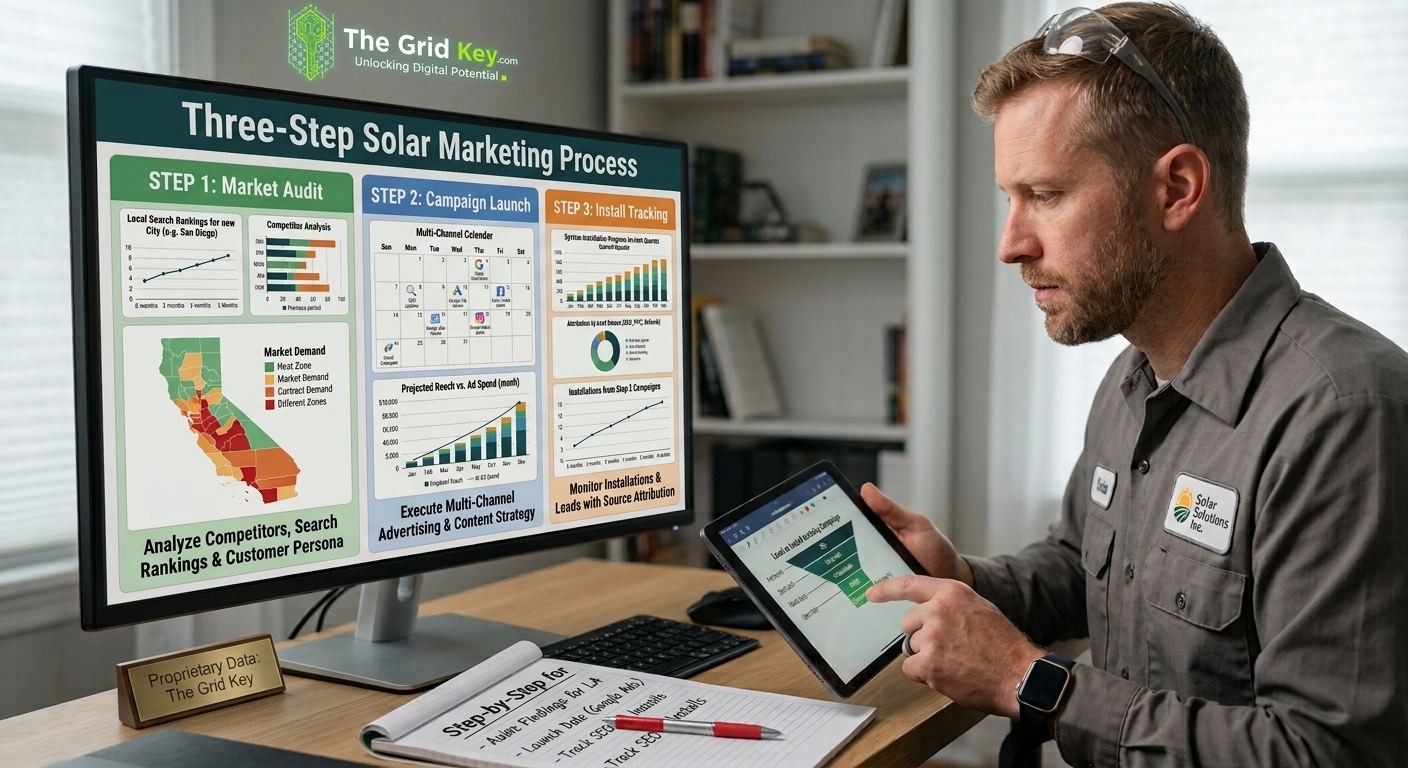
We map your install territory against every competitor, aggregator and TPO brand holding the search results in it. Site crawl, Google Business Profile audit, ad account teardown, review gap, and a compliance pass on every savings and incentive claim currently live on your site.
The plan is built around your model. A cash-and-loan EPC needs a different argument than a TPO dealer. A storage-forward installer in a market with unfavorable net metering needs a different one again. State incentive and SREC economics drive the messaging, because that is where the savings argument now lives.
We build the pages, the profiles, the campaigns and the tracking. Call tracking on every channel, GA4 configured for solar, and CRM conversion import at three stages: appointment set, contract signed, system installed. Google optimizes toward the third one.
Client Case Study
A [residential solar EPC] in [metro, state] built its entire funnel on the 30% federal credit. When 25D ended, appointment volume held but the close rate fell [X] points and cost per installed system climbed [X]%. The site still cited the credit on four pages. Most lead flow came from purchased aggregator leads that three competitors were also calling.
We rewrote every savings claim around what still applies in [state]: [state incentive], SREC value, TPO pricing, and modeled utility rate escalation. Service area pages were built for the [25] counties carrying real install volume so owned organic leads could replace purchased ones. Paid search was split by buying stage with separate landing pages. CRM conversion import connected installed system value back to the originating keyword, and budget shifted toward the campaigns producing sits rather than the ones producing the cheapest forms.
Within six months, cost per installed system fell 120%, the appointment sit rate rose [X] points, and organic leads went from 32% to 120% of total volume, which cut aggregator spend by [$40000] per month. Cancellations during permitting dropped 10%, because homeowners arrived at the consultation already understanding what they would and would not receive.
Why Choose The Grid Key

Section 25D ended December 31, 2025. Section 48E still runs through third-party ownership on a closing window. State programs and SREC markets now carry the savings argument. If an agency is still writing you "30% federal tax credit" ad copy, they are three quarters behind and every homeowner who checks will catch it.
Leads are the easiest thing to buy in solar and the least meaningful. We report sit rate, close rate, cost per installed system and cancellations. If a campaign produced 60 leads and 2 installs, the report says so in the first line.
The goal is to replace purchased aggregator leads with organic and paid leads that only you are calling. Every month of the engagement should shift that ratio, and we report it as a ratio so you can see it moving.
Solar savings claims are an active FTC and state attorney general enforcement area. Every incentive figure, payback period and savings estimate we write gets flagged for your review, with the assumptions stated. We will not publish a number you cannot defend.
Homeowners now ask ChatGPT and Google AI Overviews whether solar is still worth it without the credit, and take that answer as neutral. Every page we build is structured to be the source those answers cite: answer-first formatting, solar schema, entity consistency across your profiles.
Month to month with 30 days notice. If we stop producing installs, you leave.
“Within 6 months we went from page 3 to the top 3 results for every target keyword. Our lead volume tripled and revenue is up 280%. Best investment we have ever made.”
CEO, Thompson Roofing Co.
“I was skeptical about digital marketing but they showed me the numbers every step of the way. 420% increase in organic traffic and our phone hasn’t stopped ringing.”
Owner, Foster HVAC Solution
“They built us a conversion machine, not just a website. We went from 45 new patients per month to 140. The SEO alone paid for itself within 60 days.”
Practice Owner, Patel Dental Group
“Our cost per appraised case dropped from $2,400 to $280 after they rebuilt our Google Ads campaigns. The ROI is extraordinary.”
Managing Partner, Walsh Personal Injury
“They understand our industry better than any agency we’ve worked with. 530% organic traffic growth in 8 months with zero fluff, all measurable.”
VP Marketing, SolarRidge Installations
“Our booking calendar went from 60% to 100% full within 3 months. The combination of SEO, PPC, and social media management is exactly what our boutique spa needed.”
Owner, Kim Med Spa & Aesthetics
Free Website & SEO Audit
In one focused review, we’ll show you the gaps in your website, SEO, and local visibility and the fastest path to fix them.
Claim your free audit
Get a free breakdown of your solar website, your ranking position county by county, every page still citing a credit that no longer exists, and where your ad spend is going to traffic that never sits. Prioritized action plan included. No obligation, no contract, no pitch deck.
By rebuilding the savings argument on what still applies: state incentives, SREC markets, utility rebates, third-party ownership pricing, and modeled utility rate escalation over the system’s life. Section 25D ended December 31, 2025 for purchased residential systems, so any campaign still leading with a 30% federal credit is both ineffective and a compliance risk. Section 48E still applies to leases and PPAs where the system owner claims it, on a closing window.
Most US solar installers invest between $3,000 and $15,000 per month depending on territory size and channel mix. Our minimum engagement is $2,500 per month. Ad spend is separate and paid directly to Google, never marked up by us.
Ranking movement typically appears in 60 to 90 days, with meaningful lead volume around month six and installs following your own sales cycle after that. Because solar cycles run long, we report leading indicators monthly and cost per installed system quarterly.
Keep them while you build owned pipeline, then reduce them as organic volume replaces them. Aggregator leads are sold to multiple installers, so your close rate on them will always trail leads that only you are calling, and the goal of the engagement is to move that ratio month over month.
Yes, all of it. The Google Ads account, Google Business Profile, website and call tracking data stay in your name. If you leave, nothing gets switched off and nothing goes with us.